
 EN
 EN
 CN




Machine Stability for Metal Forging Operations
Cold forging and warm forging are widely used in automotive, motorcycle, bicycle, and hardware manufacturing. These processes require suitable pressing force, stable machine structures, and controlled slide movement to meet different metal forming requirements.
During production, insufficient machine rigidity or unstable slide movement can affect forming accuracy and production consistency. Energy consumption and equipment maintenance are also important considerations for manufacturers operating hydraulic presses.
The CMHe Series Frame-Type Guided Servo Hydraulic Press from COSMOS PRESS is designed for cold forging, warm forging, metal extrusion, pressing, shallow drawing, and blanking. Its welded frame structure, eight-face guideway design, and servo-driven hydraulic control make it suitable for precision metal forming applications.
imageimageimageimageimage
1. Stable Machine Structure for Forging Operations
During cold and warm forging, the press needs to withstand substantial working loads while maintaining stable slide movement. Machine rigidity and resistance to lateral pressure are important factors affecting equipment performance.
The CMHe Series Frame-Type Guided Servo Hydraulic Press adopts an overall welded frame structure designed through finite element analysis (FEA). Its eight-face guideway design allows the slider to run along precision guide rails, providing resistance to vibration and lateral pressure.
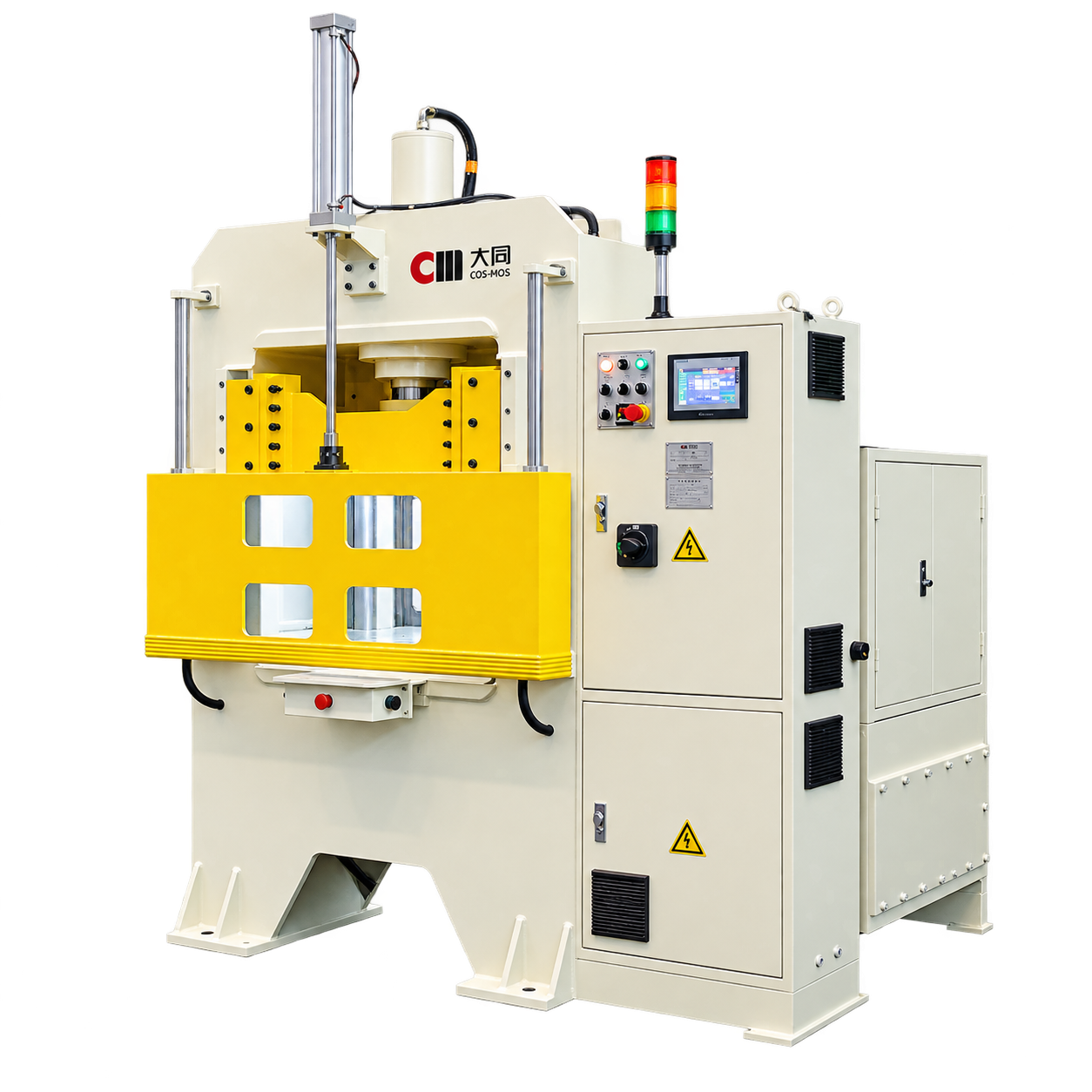
This structure offers several advantages for forging production:
Improved slide stability: Precision guide rails help maintain stable slider movement during pressing.
Reduced machine deformation: The complete frame structure provides the rigidity required for demanding forming operations.
Resistance to lateral pressure: The eight-face guideway design supports stable operation under different working conditions.
Durable machine construction: The rigid structure is suitable for repeated industrial pressing and forming processes.
These features make the machine suitable for manufacturers processing automotive, motorcycle, bicycle, and hardware components.
2. Servo Hydraulic Control for Different Forging Requirements
Cold forging and warm forging involve different forming conditions. Depending on the workpiece and processing requirements, manufacturers need appropriate pressing speeds and pressure settings.
The CMHe Series Frame-Type Guided Servo Hydraulic Press uses a servo-driven control system to accommodate varying speed and pressure requirements for different processes.
Its high-speed pressing adjustment function allows operators to set pressing conditions according to different product requirements. This flexibility is useful for production facilities handling multiple metal components and forming processes.
The servo motor-driven hydraulic pump system also optimizes power utilization according to operating requirements. Compared with conventional hydraulic drive systems, it helps improve energy efficiency while providing smoother and quieter machine movement.
3. Cold Forging Applications for Automotive and Motorcycle Components
Cold forging is widely used in metal component manufacturing where controlled forming conditions and repeatable processing are required.
The CMHe Series Frame-Type Guided Servo Hydraulic Press is designed for cold forging applications involving metal materials. Its rigid frame and precision guideway structure provide stable support during pressing operations.
For manufacturers in the automotive, motorcycle, and bicycle industries, the machine can be used in metal component production processes that require stable pressing force and controlled slide movement.
Its linear scale and pressure sensor provide position and pressure monitoring, helping operators monitor important forming conditions during production.
4. Warm Forging for Metal Component Manufacturing
Warm forging involves forming metal materials at elevated temperatures and requires pressing conditions suited to the material and forming process.
The CMHe Series Frame-Type Guided Servo Hydraulic Press provides adjustable pressing settings and servo-driven hydraulic control to accommodate different processing requirements.
Its welded frame structure and eight-face guideway design help maintain machine stability during pressing. The servo motor drive system also supports different speed and pressure requirements, making the machine adaptable to various metal forming applications.
For manufacturers producing automotive parts, motorcycle components, and industrial hardware, the equipment can be configured according to workpiece dimensions, tooling requirements, and the required pressing capacity.
5. Position and Pressure Monitoring for Precision Forging
Positioning accuracy and repeatability are important considerations in precision metal forming. Inconsistent slide positioning may affect the dimensional consistency of finished components.
The CMHe Series Frame-Type Guided Servo Hydraulic Press incorporates a linear scale and pressure sensor for position and pressure monitoring. These components help operators monitor machine movement and pressing conditions.
The machine achieves repeatability of up to ±0.01 mm, helping control waste caused by machine positioning accuracy issues.
Combined with the rigid frame structure and precision guide rails, these monitoring functions support more consistent pressing operations.
The machine is particularly suitable for precision molding parts, as well as metal forming applications involving mobile phone casings, LED heat sinks, watch casings, and hardware tools.
6. Energy Efficiency in Hydraulic Press Operations
Energy consumption is an important consideration for manufacturers operating hydraulic presses over extended production periods.
The CMHe Series Frame-Type Guided Servo Hydraulic Press adopts an advanced servo-driven hydraulic pump system. The servo motor drive adjusts operation to accommodate different speed and pressure requirements during processing.
Compared with conventional hydraulic presses, the system can achieve energy savings of approximately 20–50%, depending on operating conditions and production processes.
Additional features include:
Optimized power utilization through servo motor control.
Smoother and quieter machine movement.
Low cooling water consumption.
Support for different pressing speeds and pressure requirements.
These features help manufacturers improve equipment energy efficiency and manage operating costs.
7. Convenient Maintenance and Customized Production Integration
Equipment maintenance and production integration are important considerations when selecting an industrial hydraulic press.
The CMHe Series Frame-Type Guided Servo Hydraulic Press adopts a modular structure designed according to different functional configurations, making machine disassembly and assembly more convenient.
Its user-friendly human-machine interface allows operators to set processing parameters and save settings for different production requirements. General equipment malfunctions can also be observed and addressed through the touch screen, simplifying maintenance.
For manufacturers planning automated production, COSMOS PRESS can customize auxiliary equipment according to different production requirements. This provides flexibility when integrating the hydraulic press into specific manufacturing processes.
CMHe Series Frame-Type Guided Servo Hydraulic Press for Metal Forging
The CMHe Series Frame-Type Guided Servo Hydraulic Press combines an FEA-designed welded frame, eight-face guideway structure, servo-driven hydraulic control, and position and pressure monitoring.
It is mainly suitable for cold forging, warm forging, metal extrusion, pressing, shallow drawing, and blanking. Its applications include automotive, motorcycle, bicycle, mobile phone casings, LED heat sinks, watch casings, and hardware tools.
For manufacturers seeking a servo driven frame hydraulic press for precision metal forming, COSMOS PRESS offers customizable machine configurations and auxiliary equipment based on specific production requirements.