
 EN
 EN
 CN




In precision metal forming, repeatability directly affects the consistency of finished parts. When producing watch cases, watch straps, glasses, or metal badges, manufacturers need each pressing cycle to deliver consistent forming results. Variations in pressing position and pressure can lead to differences in product dimensions and forming depth, increasing scrap rates and inspection requirements.
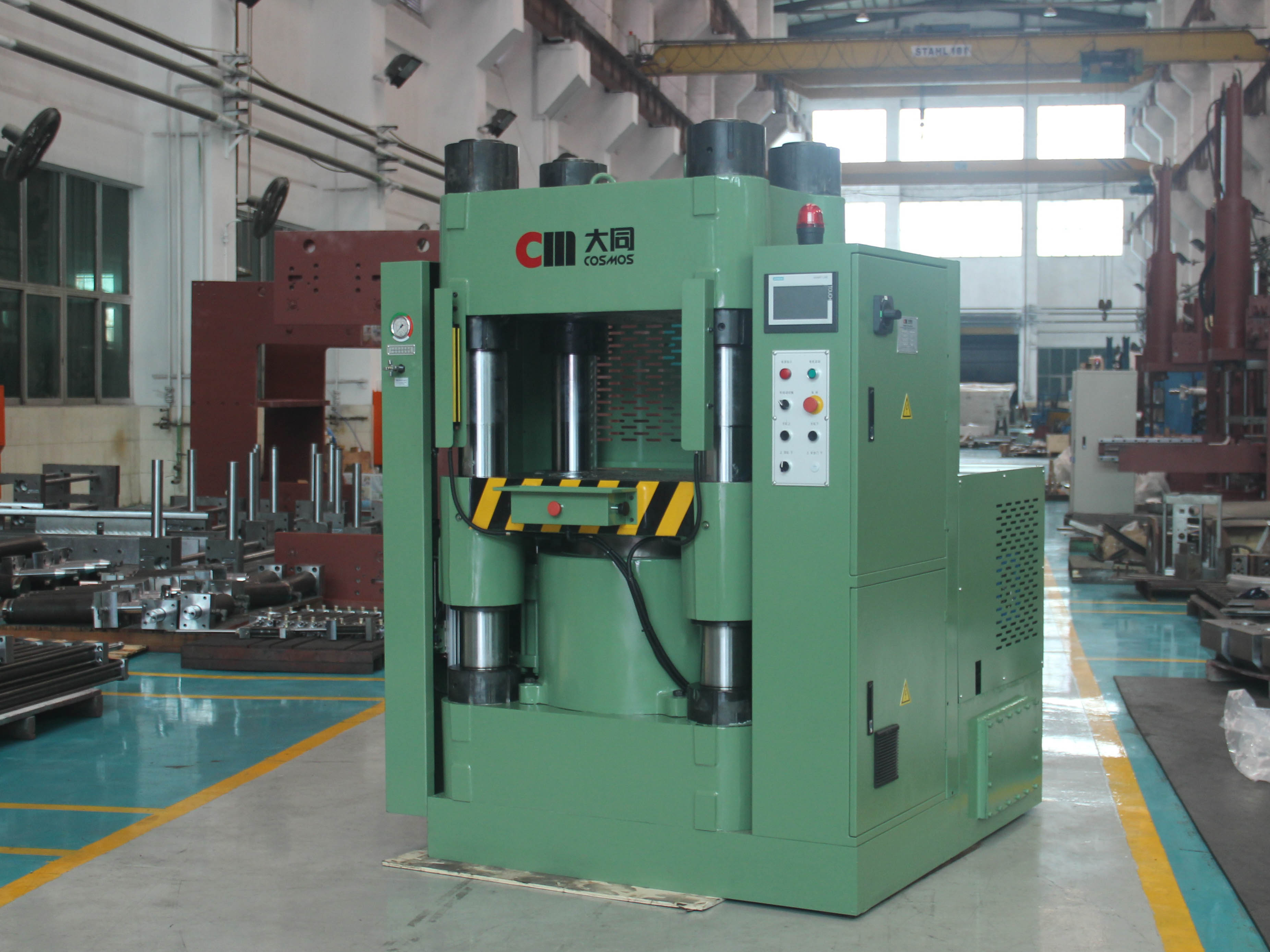
The CMSe Series Four-Column Single-Action Up-Stroke Servo Hydraulic Press from COSMOS PRESS is designed for metal pressing applications that require accurate and consistent forming results. With a repeatability of ±0.01 mm, the series combines position monitoring, pressure monitoring, and servo-driven control to support precision pressing operations.
How Does Poor Repeatability Affect Metal Forming?
Consider the production of metal watch cases. Each workpiece needs to undergo a controlled pressing process to achieve the required shape and dimensions. If the moving bolster does not return to a consistent working position, or if pressing pressure varies between cycles, the finished parts may show differences in forming depth.
Similar problems can occur when pressing watch straps, glasses frames, and commemorative badges. Inconsistent forming results can lead to dimensional deviations, additional quality inspections, and rejected parts.
For manufacturers, these issues mean more material waste and less efficient production. Improving repeatability helps reduce scrap caused by pressing accuracy issues and makes batch production more consistent.
The CMSe up-stroke servo hydraulic press incorporates several functions to help maintain consistent pressing conditions.
1. Position Monitoring with a Linear Scale
The moving bolster position is an important factor in controlling forming depth. During repeated pressing operations, position variations can affect the final dimensions of metal components.
The CMSe series uses a linear scale to monitor position. This provides position information during machine operation and helps improve pressing accuracy.
For applications such as watch case and metal badge forming, accurate position monitoring supports more consistent pressing operations.
2. Pressure Monitoring with a Pressure Sensor
Different forming applications require different pressure conditions. For example, pressing a watch case and forming a metal badge may involve different process requirements.
The CMSe series uses a pressure sensor to monitor pressing pressure. Together with its servo-driven control system, this helps the machine meet the varying pressure requirements of different forming processes.
3. Servo-Driven Control for Different Forming Stages
A metal forming process may require different movement speeds during approaching, pressing, and returning stages.
The CMSe servo-driven hydraulic system adjusts to different speed and pressure requirements, resulting in smoother machine movements. This is useful for manufacturers who need to configure pressing conditions for different products and production processes.
4. Process Parameter Storage for Repeated Production
When manufacturers switch between different workpieces, they often need to use different processing parameters.
The CMSe series features a human-machine interface with process parameter storage. Operators can store process parameters for production use, reducing the need to repeatedly configure the same settings when returning to an established process.
For manufacturers producing multiple types of metal components, this function makes process management more convenient.
Structural Design and Capacity for Different Forming Applications
In addition to its monitoring and control functions, the CMSe series uses finite element analysis to improve structural rationality and rigidity. A rigid machine structure helps maintain stable operating conditions under pressing loads and supports forming accuracy.
The CMSe series offers models from CMSe-200 to CMSe-3000, with nominal capacities ranging from 200 to 3000 tons. Manufacturers can select a suitable model according to their required pressing capacity and workpiece dimensions.