 EN
 EN
 CN




Energy efficiency plays an important role in metal forming, where repeated pressing operations, high forming forces, and production cycle times directly affect manufacturing costs. Unnecessary energy consumption, inconsistent forming results, and inefficient machine operation can increase costs and reduce productivity.
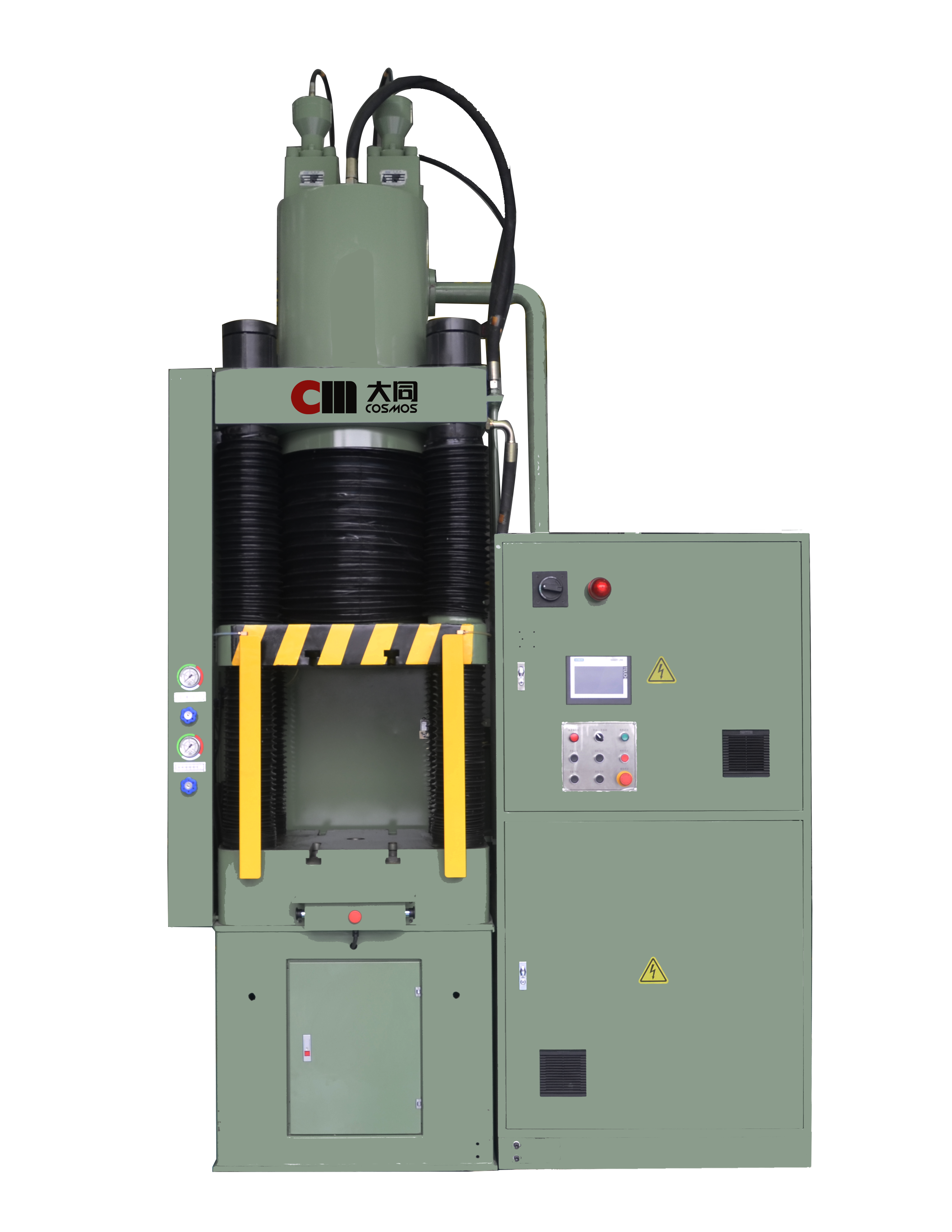
At COSMOS PRESS, we provide cold extrusion servo hydraulic press solutions designed to help manufacturers optimize energy use and improve production efficiency. Our CMLJ Series Four-Column Cold Extrusion Servo Hydraulic Press integrates a servo-driven hydraulic pump system, adjustable pressing parameters, and position and pressure monitoring to support efficient and consistent metal forming.
1. Optimize Energy Consumption with Servo Hydraulic Technology
During metal forming, different stages of a press cycle require different movement speeds and pressure levels. Rapid approach and return movements do not necessarily require the same operating conditions as high-pressure forming. When hydraulic system operation does not match actual process demands, energy may be used inefficiently.
Our CMLJ Series features an advanced servo-driven hydraulic pump system designed to improve energy efficiency. The servo drive supports varying speed and pressure requirements for different forming processes, helping align machine operation with production demands.
This approach helps manufacturers improve energy utilization during repeated production cycles while maintaining the forming force required for their applications. The actual energy savings depend on the workpiece, production cycle, operating conditions, and comparison equipment.
2. Adjust Pressing Parameters for Different Forming Requirements
Cold extrusion, warm forging, pressing, shallow drawing, and blanking involve different forming conditions. Unsuitable movement speeds or pressing parameters can extend production cycles, affect forming stability, or compromise finished-part quality.
The CMLJ Series supports adjustable pressing parameters to accommodate different workpieces, tooling configurations, and production requirements. Its servo drive system supports varying speed and pressure demands across different forming applications.
By configuring suitable operating parameters for each process, manufacturers can balance production speed with forming stability and product quality. For example, the CMLJ-300 has an approach speed of 250 mm/s, a pressing speed of 10–20 mm/s, and a return speed of 300 mm/s. These specifications help customers evaluate machine movement capabilities when planning production cycles.
Actual cycle time depends on the workpiece, die design, forming process, and loading and unloading arrangements.
3. Improve Forming Consistency with Position and Pressure Monitoring
Dimensional deviations and inconsistent forming conditions can lead to rejected parts, material waste, and rework. For manufacturers producing precision metal components, repeatable positioning and controlled forming conditions are important for maintaining product consistency.
Our CMLJ Series is equipped with linear scales and pressure sensors for position and pressure monitoring. The machine offers a stated repeatability of ±0.01 mm, supporting precise and consistent positioning during repeated operations.
Position and pressure monitoring provide important information for controlling machine movement and forming conditions. When combined with suitable tooling, material preparation, and process parameters, these functions help manufacturers maintain repeatability and reduce quality problems associated with positioning deviations.
These capabilities are useful for applications such as automotive components, hardware tools, and metal housings. Actual component tolerances depend on workpiece design, material properties, tooling, and production conditions. Improved forming consistency can also help reduce avoidable scrap and rework, making better use of materials and production resources.
4. Improve Production Efficiency Through Cycle Optimization
Long production cycles can limit output and increase the energy consumed per finished component. However, simply increasing pressing speed may compromise forming stability or product quality if the process requires controlled deformation.
The CMLJ Series combines servo hydraulic technology with adjustable pressing parameters to accommodate different operating requirements. Its movement speeds and forming settings can be configured according to the workpiece, tooling, and production process.
By optimizing approach, pressing, and return movements, manufacturers can identify opportunities to reduce avoidable delays while maintaining the force and process control required for metal forming. The appropriate balance between speed and pressure helps support stable production without relying solely on faster machine movement.
Actual productivity gains depend on the forming process, tooling, material handling, and overall production line configuration.
5. Select the Right Press Capacity for Your Production Needs
Selecting a hydraulic press requires more than considering nominal tonnage. Forming force, workpiece dimensions, die size, stroke, working space, and production volume all affect equipment suitability.
Our CMLJ Series offers four standard models to support different metal forming requirements:
CMLJ-300: 300-ton nominal capacity, 450 mm maximum moving bolster stroke, and 32 kW motor power.
CMLJ-500: 500-ton nominal capacity, 500 mm maximum moving bolster stroke, and 55 kW motor power.
CMLJ-650: 650-ton nominal capacity, 500 mm maximum moving bolster stroke, and 55 kW motor power.
CMLJ-1000: 1,000-ton nominal capacity, 500 mm maximum moving bolster stroke, and 78.6 kW motor power.
These options allow manufacturers to compare press capacity, working dimensions, and motor power against their actual forming requirements. Selecting a suitable configuration helps ensure that the machine can accommodate the required forming force, tooling, and production process.
Motor power ratings alone do not determine actual energy consumption. Comparing electricity use under representative production conditions provides a more meaningful assessment of operating efficiency.
6. Support a Wide Range of Metal Forming Applications
Different metal components require different combinations of forming force, tooling, movement, and process control. Selecting suitable equipment helps manufacturers achieve the required forming performance while managing production resources.
The CMLJ Series is designed for cold forging, warm forging, metal extrusion forming, pressing, shallow drawing, and blanking. Its applications include automotive, motorcycle, and bicycle components, mobile phone casings, LED heat sinks, watch casings, and hardware tools.
With multiple standard capacities and customizable automation options, the CMLJ Series can accommodate different production requirements. The appropriate configuration depends on the workpiece material, dimensions, forming force, tooling arrangement, and expected output.
Evaluating these factors before equipment selection helps manufacturers identify a press that fits their production process and supports consistent operation.